How to Jump Higher ASAP!
Two things you can fix right now without getting stronger or gaining muscle.
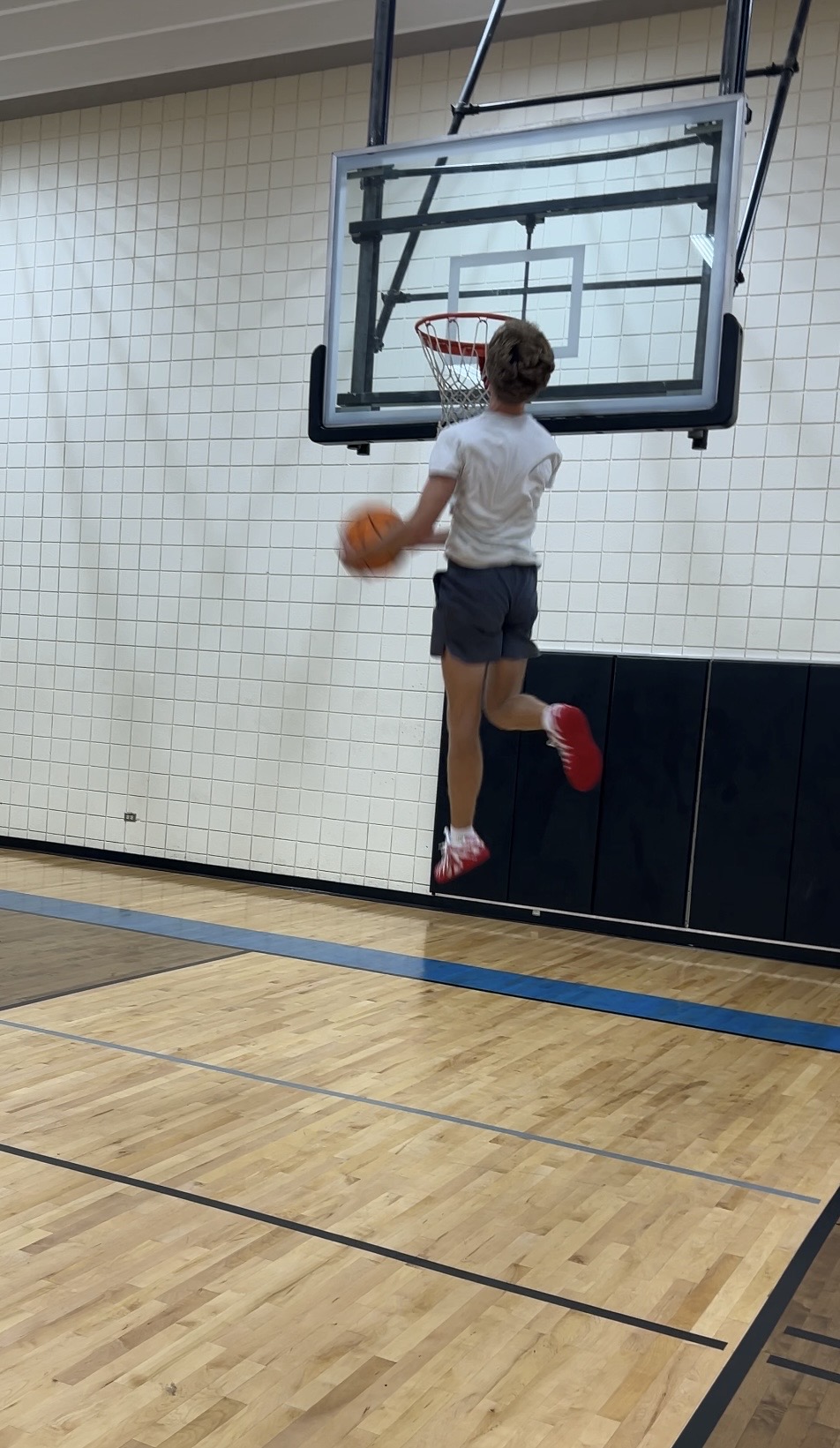
How to Jump Higher ASAP!
If you want to jump higher, you might think you need to get stronger, do more plyometrics, or start lifting heavier.
Those things can absolutely help.
But there are two things you can work on right now that can make a huge difference in your vertical without getting stronger or gaining muscle: your jump form and your penultimate step.
These are the first things I would work on if I were trying to increase my vertical.
1. Perfect Your Jump Form
The number one thing you can do to instantly increase your vertical is perfect your jump form.
There are different types of jumps, and your technique depends on how you jump. You might be a one-foot jumper, a speed jumper, a one-foot power jumper, or a two-foot jumper using either right-left or left-right.
Whatever your jumping style is, you want to make the movement as efficient as possible.
Your goal isn't just to jump hard.
Your goal is to use the force you already have as efficiently as possible.
And this actually matters more than most people think.
Research on vertical jump performance shows that technique and coordination can significantly influence output. In fact, studies on countermovement and approach jumps show that arm swing alone can increase jump height by 10 to 20% compared to no arm swing (Lees et al., 2004; Harman et al., 1990). That's not strength. That's mechanics.
When your approach, plant, arm swing, torso position, and takeoff timing are working together, you can get more height without necessarily becoming stronger.
In my experience, cleaning up jump technique can be worth two to three inches of vertical.
That is one of the easiest inches you'll ever gain because you aren't building anything new. You're learning how to use what you already have.
2. Perfect Your Penultimate Step
The second major piece is your penultimate step.
If you don't know what that means, the penultimate is simply the second-to-last step before you take off.
For example, if you're doing a one-foot jump, your penultimate is the step immediately before your final plant.
This step is extremely important because it's where you can take the speed and momentum from your approach and convert it into vertical force.
Think of your approach like loading a spring.
You're building horizontal speed, then your penultimate and final plant help you redirect that energy upward.
Biomechanics research backs this up: elite jumpers don't just run faster. They manage braking forces and center-of-mass positioning more efficiently during the penultimate step, which allows better energy transfer into vertical lift (Dowling & Vamos, 1993).
If you get the penultimate wrong, you can waste a huge amount of the speed you just created.
If you get it right, your jump can feel completely different.
Perfecting my approach and penultimate has been one of the biggest parts of improving my own jumping.
For some athletes, I believe improving the penultimate and overall approach mechanics can be worth three to five inches of vertical.
And unlike gaining five inches of strength, this is something you can start improving immediately.
You Can Improve These Quickly
One of the best parts about technique work is that you don't necessarily need months to see improvement.
Motor learning research shows that new movement patterns can begin to improve within a few focused practice sessions, especially when feedback (like video) is used consistently.
If you actually focus on your jump mechanics and practice them consistently, you can make noticeable changes within days.
I'd spend time every day practicing your approach, penultimate, plant, arm swing, and takeoff.
Don't just mindlessly jump over and over.
Practice the movement.
Film yourself.
Compare your jumps.
Figure out what is going wrong.
Then repeat it until the movement starts becoming natural.
You don't need to turn every technique session into a max-effort workout. You're trying to teach your body a better movement pattern.
3. Stay Consistent and Stay Healthy
Once your technique is solid, the next thing is simple:
Be consistent.
There isn't a magic workout that will make you jump five inches higher overnight.
Long-term improvement comes from consistently doing the things that make you a better athlete.
That means:
- Do your plyometrics.
- Lift consistently.
- Practice your jumping.
- Get enough sleep.
- Stay hydrated.
- Eat a balanced diet.
- Get enough protein (research suggests ~1.6 to 2.2g/kg bodyweight supports athletic performance and recovery).
- Get your vitamins and minerals from a good diet.
- Give your body enough time to recover.
Most importantly, stay healthy.
The last one is underrated.
You can't improve your vertical if you're constantly injured.
And the data backs that up too. Injury rates in explosive sports like basketball and volleyball are high enough that missed training time is one of the biggest barriers to long-term performance gains.
Your training stimulates your body. Your recovery is when your body actually adapts.
So don't fall into the trap of thinking that more training always means more progress.
Sometimes the best thing you can do is recover so that you can come back and train hard again.
The Simple Formula
If I had to simplify vertical jump training, I'd put it like this:
Technique, then Strength, then Power, then Consistency, then Recovery.
Start by learning how to use your current athletic ability.
Then build more strength and power.
Then stay consistent long enough for your body to adapt.
And don't forget the recovery that allows all of it to happen.
You don't need to wait six months to start jumping higher.
Start with your technique.
Perfect your jump form.
Perfect your penultimate.
Then build your athletic ability on top of that foundation.
Sources
- Harman, E. A., Rosenstein, M. T., Frykman, P. N., & Rosenstein, R. M. (1990). The effects of arms and countermovement on vertical jumping.
- Lees, A., Vanrenterghem, J., & De Clercq, D. (2004). Understanding how an arm swing enhances performance in the vertical jump.
- Dowling, J. J., & Vamos, L. (1993). Identification of kinetic and kinematic factors in vertical jumping performance.
- International Society of Sports Nutrition (ISSN) Position Stand on protein intake (2017).